Why Trying Harder Isn't Working
 Karren Kerrisk


More effort feels responsible, but it often backfires. Discover what goal research says about effort versus clarity, and the quick check to run before pushing harder.
You know that feeling of working harder than you've ever worked and still going to bed every night sure it wasn't enough? Let's talk about that, because it's almost never about effort.
I'm working with a coaching client at the moment. Let's call him Dan. He's a few months into a big new role, sharp, capable, and he hit the ground running. He's also pulling 60-hour weeks and burning the candle at both ends, trying to learn absolutely everything fast enough to finally feel good at the job.
Here's the catch. Nobody has ever actually told Dan what "good at the job" looks like. Not his manager. Not him. Somewhere along the way, someone told him to hit a target. No one has set it up yet.
So the hours keep climbing. The laptop stays open past 10pm, doing a very convincing impression of productivity.
Want to know what it actually sounds like in his head by then? Something like this.
Is this good enough? Should I already know this? Everyone else seems to already know this. I should read the policy again. Have I even read the whole thing? Did I miss something?
Notice what's not in there anywhere. Not one single question about what "good" is actually supposed to look like.
I see this often. I hear it in the way people talk about their work, like exhaustion is just the cost of entry.
Here's why. "Good" was never going to be a tidy standard someone could hand you in a staff meeting. It's personal. It's built out of what you value and how you want to feel about your own work, usually some version of confident, competent, and adding value, instead of just filling a seat and answering emails. Dan's version of "good" was definately undefined. Looking for a target that hadn't been set up, wondering why he couldn't hit it
You might be doing exactly the same thing. On your own. Right now.
When you never define your own criteria for success, your brain defaults to "more." More effort, more checking, more overthinking. You can tick off every item on your list and still lie awake at midnight, replaying the whole day like a highlight reel nobody wants to watch twice.
I see this pattern often in high-performing clients. And in my own very stubborn self, (no surprises there). Something isn't landing, and the instinct isn't to stop and ask why. The instinct is to do the exact same thing again, just harder.
Longer hours. More willpower. A sterner talking-to in the bathroom mirror. Another five-point plan, drawn up at 11pm, by a brain that should have clocked off three hours ago.
And it doesn't work. If raw effort were really the missing piece, that should be impossible. Effort was never the problem. It never had anywhere to land.
What trying harder looks like
Does this sound familiar? Even just one?
"I just need to tighten up my discipline." You're already up at 5am, making the lists, working through lunch like it's a competitive sport. You don't lack discipline. The plan is stalling because nobody, least of all you, can say specifically what "done" looks like for the day.
"I'll push through this week and catch up." So you grind through to Friday, arrive home running on empty, and Monday turns up with the same pile waiting. All that extra effort did was move the deadline. It never touched the target.
"If I just want it enough, I'll find a way." Wanting it harder isn't a strategy. It's stress, dressed up as ambition.
"I've tried everything." Usually what's actually been tried is the same strategy, worn six different ways, because the real target was never pinned down to begin with.
None of this is about laziness. It's a lot of real, intense effort with nowhere clear to land.
What the research says about effort and clarity
This isn't just a coaching hunch, or pop psychology. Edwin Locke and Gary Latham spent over three decades studying goal setting, across hundreds of studies. Their summary paper opens with a line that captures 35 years of research: specific, clear goals reliably outperform vague ones, even when the vague goal is the ever-popular "do your best."
Not because clear goals make you work harder. They work because they tell your effort where to go, the way "second street on the left" beats "it's over there somewhere."
Vague targets force your mind to guess at what counts. And when you're guessing, your effort spreads thin, overdelivers on the wrong details, or just runs out of steam.
That's the formal research. Here's what my two decades of training in NLP adds to it.
Your brain has a filter called the Reticular Activating System, or RAS, and its job is to decide what's worth your attention out of everything coming at you every second. It's part of why you suddenly see a certain car everywhere once you're thinking of buying one. The car was always there. You just weren't filtering for it.
Give your RAS something vague, like "be good at my job," and it has nothing to filter for. Give it something specific, and it starts noticing the relevant comment in a meeting, the pattern you'd otherwise have missed, without you consciously trying. Nobody's fully mapped how much of that runs below conscious awareness versus how much is just attention doing its job. Either way, a vague goal gives your own brain nothing to work with, on top of giving you nothing to work with.
So if you've been grinding on something for weeks with nothing to show for it, stop asking why you're not disciplined enough. Ask the more useful, slightly less comfortable question: do I actually know, in specific terms, what I'm aiming at?
A 60-second check before you push any harder
This isn't a question I made up on the spot. It comes from the Well-Formed Outcome, the NLP framework I use with every client, and the one we will build properly in the workshop. Here's the short version, and you can try it right now.
Before you add one more ounce of effort to whatever you're stuck on, try finishing this sentence.
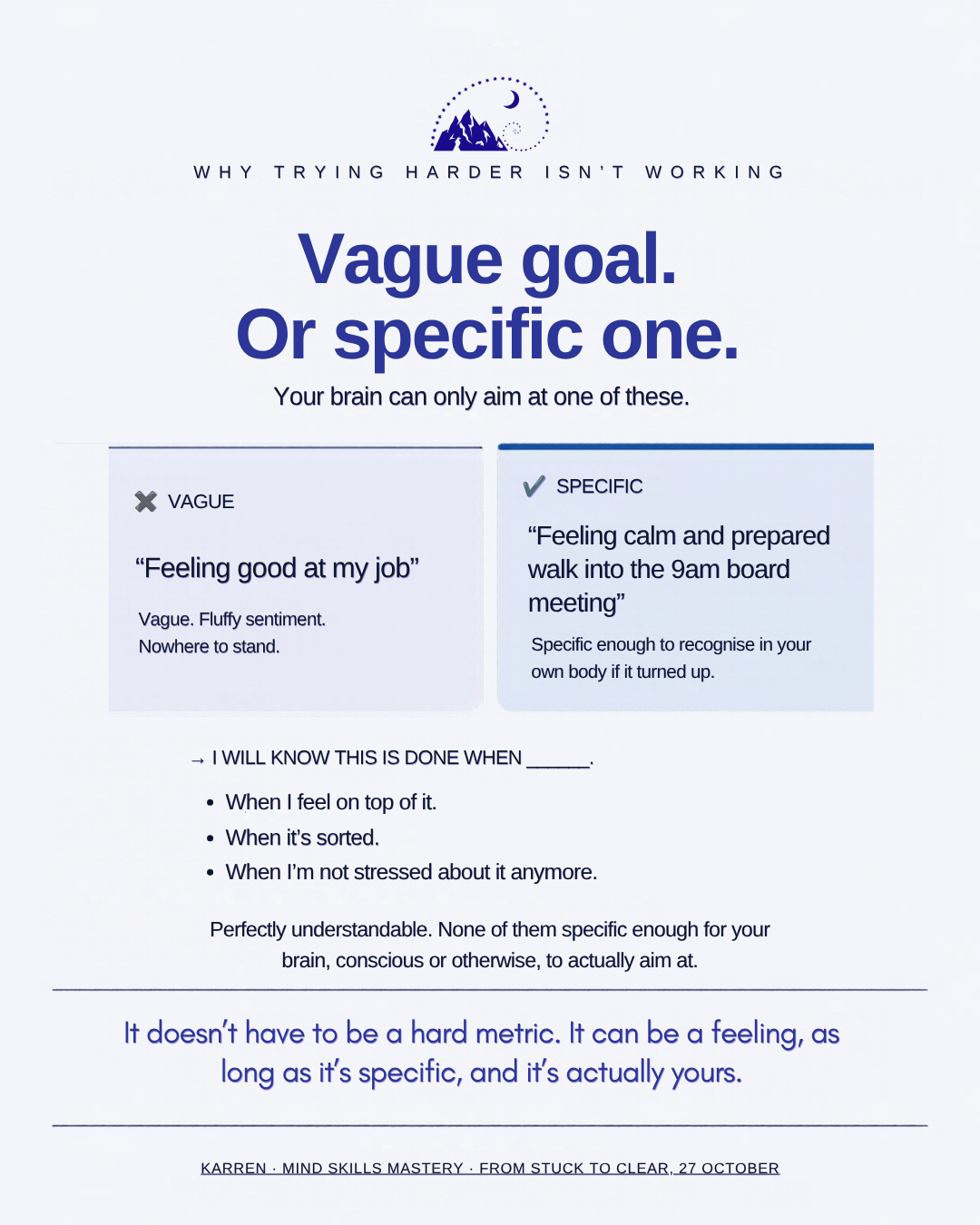
"I will know this is good enough when __."
Most people's first attempt sounds like this. "When I feel on top of it." "When it's sorted." "When I'm not stressed about it anymore." All completely understandable. None of them specific enough for your brain, conscious or otherwise, to actually aim at.
Try again. It doesn't have to be a hard metric. It can be a feeling, as long as it's specific, and it's yours: not a standard you borrowed and never checked against what you actually value.
"Feeling calm and prepared walking into the 9am board meeting" is specific. You'd recognise that in your own body if it turned up.
"Being good at my job" isn't specific. It's a lovely sentiment with nowhere to land. So ask the question underneath it: how will you actually know you're good at this? Not against someone else's scoreboard, against your own.
For some people that's confident. For others it's competent, or satisfying, or knowing the work is actually adding value instead of just filling the hours.
Define what "good" looks like, sounds like, and feels like for you, in your role, measured against what you actually value, and suddenly there's something to actually aim at.
That's the pivot. Not more effort. A clearer target.
That was the real turning point with Dan. He stopped asking how to squeeze more hours out of his week, and started asking what "good" would actually look like, specifically, so he'd know it the moment he saw it.
That one question did more for him than another month of 60-hour weeks ever could, and took considerably less coffee.
Where to go from here
Not everyone needs the full version of this to get unstuck. Some of you will get most of the way there with the one question above, scribbled on the back of an envelope tonight. Some of you will want to sit down and build the whole thing properly, outcome, obstacles, and all, which is exactly what the workshop is for. Both are fine. There's no one right way to do this.
If you took the quiz already and landed on the type who's tried properly but keeps hitting the same wall, now you know why. It's not a you problem. It's a definition problem.
If you haven't taken it yet, it takes less than two minutes. Probably less time than you've just spent rereading this looking for the part where I tell you to work harder. There isn't one. That's the whole point.
Take the Quiz: Find Out What's Really Keeping You Stuck
If you're ready to stop relying on brute force to feel on top of your work, that's exactly what we sort out in my live workshop, From Stuck to Clear, on Tuesday 27 October.
We'll build the practical side of this properly: clear criteria, less over-delivering out of habit, and your mental bandwidth back.
Register for the Live 'From Stuck to Clear' Workshop Here https://www.mindskillsmastery....
Frequently Asked Questions
Why doesn't trying harder fix a goal I'm stuck on?
Effort needs a target to be useful. Specific, clear goals outperform vague ones, not because they make you try harder, but because they tell your effort where to focus. Without one, extra effort just scatters, or turns into burnout.
What's the difference between a vague goal and a specific one?
A vague goal describes a general direction, like "be more effective" or "get on top of things." A specific goal names something you can point to and say, "yes, that happened": a clear output, a deadline, or a defined personal standard.
Why can't my manager just tell me what "good" looks like?
Because "good" isn't an external checklist. It's tied to your own standards and values, and to what makes you feel confident and competent in your work. A manager can hand you deliverables, but only you can define the internal standard that lets you close the laptop at the end of the day actually knowing you've done enough.
What is a Well-Formed Outcome in NLP?
It's a structured way of defining a goal, developed within NLP, so it's specific enough for your conscious effort and the parts of your brain running in the background, like your attention filters, to actually work toward it, instead of a vague wish with nothing to aim at. The "I will know this is done when" question above is one small piece of it. It's the framework behind my live workshop, where we build it properly for a goal you're actually stuck on.
I've put in massive effort and nothing's changing. What should I check first?
Test whether you can finish the sentence "I will know this is done when __" with something specific. If you can't, the issue isn't your discipline or your work ethic. The target needs defining before you push any harder.
Test whether you can finish the sentence "I will know this is done when __" with something specific. If you can't, the issue isn't your discipline or your work ethic. The target needs defining before you push any harder.
Sources & Further Reading
Locke, E. A., & Latham, G. P. (2002). Building a practically useful theory of goal setting and task motivation: A 35-year odyssey. American Psychologist, 57(9), 705-717.
Categories: : Mind Skills