Why Trying Harder Doesn’t Fix Self-Doubt
 Karren Kerrisk

Self-doubt doesn’t respond to effort. Here’s the loop keeping capable people stuck in “still not enough,” and the NLP technique that breaks it.
There’s a thought that runs quietly under a lot of capable, hardworking people: if I just try harder, I’ll finally feel like enough. So you try harder. You stay later, you take on more, you hold yourself to a standard that would make an All Blacks fitness test look like a gentle walk in the park. For a moment it works. Then the thought stops, but the feeling is back, a little quieter but not gone. Still not enough. So you try harder again.
That’s not a work ethic problem. It’s a loop. And no, this isn’t the bit where I tell you to love yourself more. You’ve read that post. Everyone’s written that post.
The Loop Nobody Names
Self-doubt doesn't just sit there being unpleasant. It triggers an action. For a lot of people, that action is effort. More hours. More checking. More proving. It feels like the responsible thing to do.
Except the action never answers the thought that started it. "Am I good enough" isn't a question more effort can resolve. It's a question that gets postponed. So the doubt comes back, usually at 11pm on a Tuesday when you're least equipped to argue with it, and the whole loop runs again. Your brain isn't malfunctioning. It's doing exactly what it's been trained to do, because nothing has ever stepped in and interrupted it.
The Trigger Isn’t Always a Situation
Here’s the bit people miss. The trigger for this loop isn’t always something that happens to you. Sometimes it’s just a voice, showing up in a very specific context, saying the same unhelpful thing it always says. Sometimes it’s a feeling like you don’t belong at the table.
For some people it's the thirty seconds before hitting send on an email to someone senior. For others it's the two minutes before walking into a room they used to feel completely fine in. The context changes. The voice doesn't. "Here we go again." "Don't get this wrong." "They're going to notice you're winging it." Sometimes it isn't even words, just a tightening in your chest that arrives before you've named anything at all. Either way, it's not that you have a confidence problem in general. It's that a specific trigger has a few favourite rooms and it shows up to every one of them, right on cue.
Why Trying Harder Doesn’t Work
Effort is built to solve productivity problems. Self-doubt is never a productivity problem. “I’m not good enough” isn’t a to-do list item you clear by working through it. It’s a belief, and beliefs don’t respond to hours, they respond to evidence. Specifically to evidence you’ve stopped noticing.
This is why you can have a genuinely good week, hit every target, get the praise, and still lie there running the same old commentary. The achievement didn’t get filed as evidence. It got filed as “the new bar I now need to clear.” Trying harder doesn’t lower the bar. It moves it, every time, just out of reach, like an extremely petty game of limbo.
Breaking the Loop
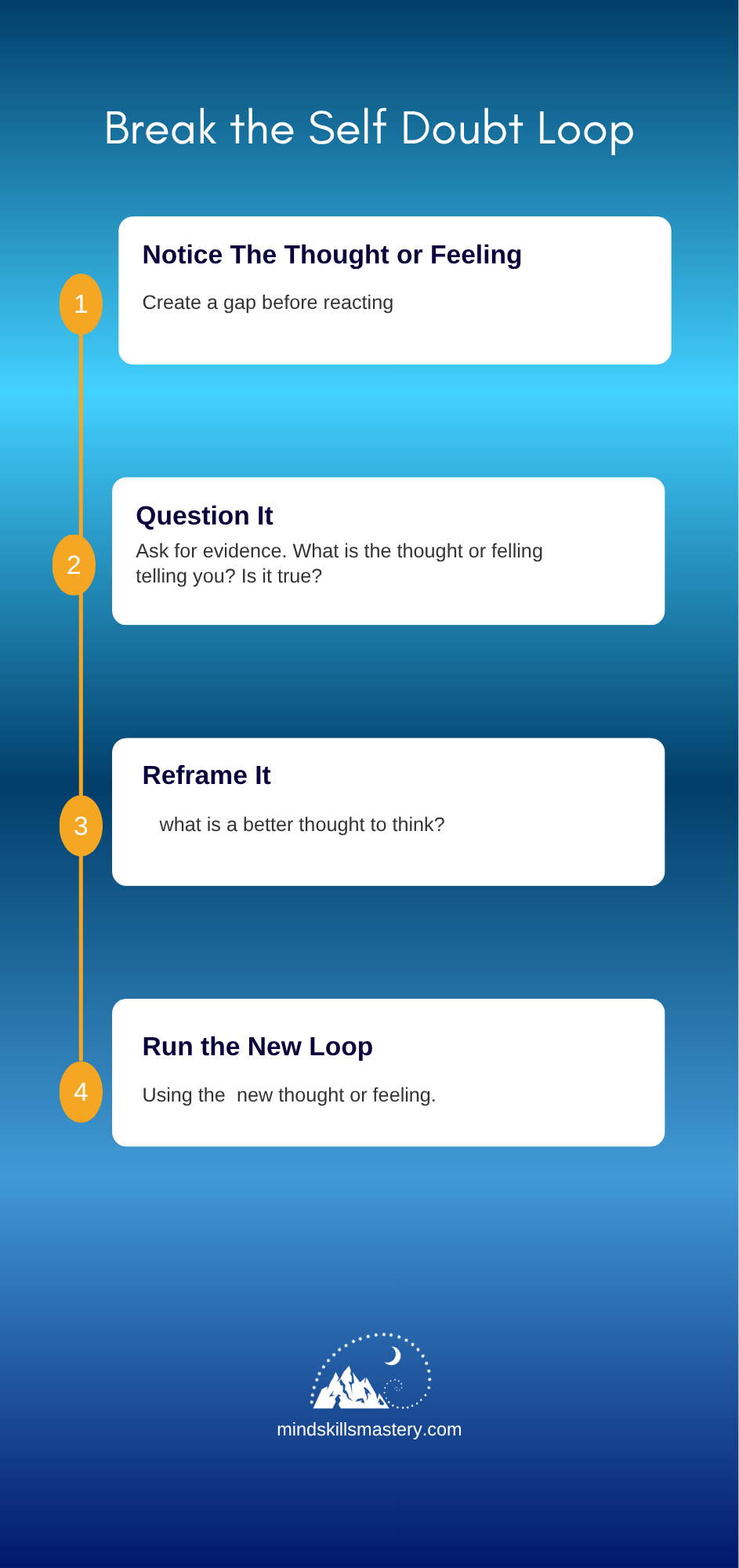
Here’s how you catch it in the moment. Unit 2 of Mind Skills Reset puts it simply: become an expert observer of your mind. Which sounds like hard work for something you can do in about ten seconds. Three steps.
1. Notice the thought. Step back far enough to catch it happening rather than being fully inside it. Just name it, plainly, even just in your head: “I’m noticing I’m having this thought.” That single sentence creates a small gap between you and the thought. In that gap, you’re not the thought anymore, you’re the one looking at it. You are not your thoughts. You’re the one thinking them, and the thinker gets to have a say.
2. Question it. Ask yourself what’s backing this thought up. Not the feeling, the evidence. What’s really true here, and what have I got that proves it? Most of these thoughts have been running unchallenged for years. Nobody’s ever pulled them up on it.
3. Reframe it. The module walks through this properly, using a piece of language most people never think to check: the gap between “I am not good enough” and “I’m having the thought that I’m not good enough.” One is an identity. The other is just weather passing through.
The loop breaks not because you worked harder, but because you finally stopped to check whether the thought driving all that effort was even telling you the truth.
Where This Comes From
This isn’t a reframe made up on the spot. The “question it” step is the Meta-Model, a set of precision questions developed by Bandler and Grinder to catch the generalisations and distortions hiding inside a sentence like “I’m not good enough.” Meta modeling makes a fuzzy claim show its evidence.
The “reframe it” step comes from their work on reframing, changing the meaning of an experience by changing the frame around it, not by pretending the experience didn’t happen.
Neither one is a mindset trick someone invented for a blog post. Both were built to be repeatable, which is the entire point of the loop breaking rather than just pausing for a moment.
References: Bandler, R., & Grinder, J. (1975). The Structure of Magic I: A Book About Language and Therapy.
Bandler, R., & Grinder, J. (1982). Reframing: Neuro-Linguistic Programming and the Transformation of Meaning.
A Friend Who Already Had the Evidence
A friend of mine was offered a leadership role, leading the team he already worked in. Everyone around him wanted him to take it. He hesitated, because he’d never officially been “the leader” before. Except he had. Every time the previous manager was away, he was the one running the room, initiating ideas, guiding the team through whatever needed guiding. The evidence was sitting right there. He’d just never stopped to check for it.
We worked out how he wanted to feel and show up as a leader, then built a simple development plan so he could answer the doubt with learning and discovery instead of white-knuckling through it. He took the role.
He didn’t need to try harder to earn the role. He needed to do exactly what Breaking the Loop describes: stop, and notice the evidence that was already there.
Want to Take This Further?
What’s here is enough to catch the loop once. Module 2 goes further, walking through the full reframe framework properly, with a fillable workbook to practice it until it’s automatic, not just understood.
And self-doubt is only one loop. The same trigger, thought, emotion, action, habit sequence runs the procrastination spiral, the conflict trigger, and half a dozen other patterns quietly running your day. Mind Skills Reset works through all of them, ten modules, real NLP tools, $47, lifetime access.
Frequently Asked Questions
Why do I still doubt myself even when I’ve already proven I can do the thing? Because proof and belief are processed differently. An achievement doesn’t automatically get filed as evidence against a long-running thought. Without a deliberate step to check the evidence, the brain keeps running the old pattern regardless of what’s actually happened.
Is self-doubt a personality trait or something that can change? It’s a pattern, not a fixed trait. NLP treats it as a changeable sequence, not a permanent feature of who you are, which is also what the research on repetitive negative thinking supports.
Why does working harder make self-doubt worse instead of better? Effort is built to solve productivity problems. Self-doubt isn’t a productivity problem, so effort doesn’t touch it. The actual thought or feeling driving the doubt never gets addressed, which is why it comes back, usually asking for even more next time.
What’s the technique in this post, and where does it come from? It’s a three-step process from Module 2 of Mind Skills Reset: notice the thought, question the evidence behind it, then deliberately reframe it. It’s not a shortcut or a mindset trick, it’s a repeatable way to interrupt the same loop every time it starts.
Categories: : NLP