The Real Reason You Never Finished That Course You Bought
 Karren Kerrisk

You didn't lack motivation, you lacked a plan. The psychology behind unfinished courses and ebooks, and the one sentence that closes the gap
I was cleaning out my computer files last week. Years overdue, if I'm honest.
And there they were. Ebooks I'd downloaded and read just once. A content strategy course I bought in a fit of inspiration at 11pm and opened twice. A mindfulness workbook sitting in a folder labelled, with real optimism, "DO THIS."
Oh, that one. I remember buying that. I never even opened it.
Here's what got me curious though. It wasn't the guilt. I'm an NLP trainer, I made peace with guilt as a strategy a long time ago. It was the question underneath it: why did buying that course feel so much like progress, when nothing about my evenings had changed?
If you've got a folder like mine, and you do (everyone does), you already know the cost. It's not only the money. It's the quiet evidence you've been collecting against yourself every time you scroll past it. "I'm just not someone who finishes things." Not true. By the end of this, you'll have one sentence that does more than the course did, and it’ll cost you nothing.
The Folder Everyone Has
Let's be honest about what's in there.
A few books you fully intended to read past chapter two. A program you signed up for because the sales page described, with eerie accuracy, exactly how stuck you felt that week. Maybe a habit tracker you used for nine glorious days, or a planner so beautiful you didn't want to "ruin" it by writing in it.
None of this is a laziness story. You're not lazy. You bought the thing. You read the description, made the decision and paid real money. That's not nothing.
And it isn't only courses. It's the health check you keep meaning to book. The pitch email that's been sitting in drafts since March. The conversation with your partner you've rehearsed in the shower a dozen times and still haven't had out loud. Same pattern, different folder.
The problem isn't that you didn't care enough to start. The problem is that almost nobody tells you what happens, psychologically, in the five minutes after you hit "buy," or "decide," or "I'll do it tomorrow."
Why Your Brain Logs Buying as Doing
Turns out there's a name for people like us. Researchers call us“inclined abstainers”, which just a way of saying "meant it at the time." Psychologist Paschal Sheeran spent years studying this exact group, and gave the space between meaning to do something and doing it its own name: the Intention-Action gap. From here on, I'll call it the gap. That's what it feels like from the inside anyway. Not the people who never wanted to change. The people who wanted to, fully meant it, and still didn't move an inch.
Here's the bit that let me off the hook, a little. This isn't a willpower problem. It's a wiring one. Buying the course is a real action. You get the confirmation email, the small buzz of "I'm doing something about this," the story where you're already becoming the tidier, calmer, more sorted version of you. Your brain ticks a box. But it’s not the box that changes anything.
So you end up with a folder full of proof that you tried, a week that looks exactly like last week, and no idea why.
The Belief Worth Dropping
Here's what's running underneath the folder and the guilt: somewhere along the way, deciding started to feel like doing.
"I bought it" quietly turned into "I did it." "I've decided to change" started to feel suspiciously like change had already happened. Easy mistake to make. Deciding does feel like something. It’s just not the thing you paid for.
So maybe the information was never the problem. You've got plenty of it, good information too. What you didn't have was a plan for the five minutes after you decided to use it.
One more thing while we're here. This isn't an argument against buying courses. It's an argument against buying ones with no plan attached.
Before you buy the next one, ask a question: who's checking whether I actually showed up? A course built around a community, a coach, or a check-in has already answered that question for you, which is why those tend to get finished. The ones that don't are usually the ones that hand you the information and leave the rest entirely up to you.
The One-Sentence Fix
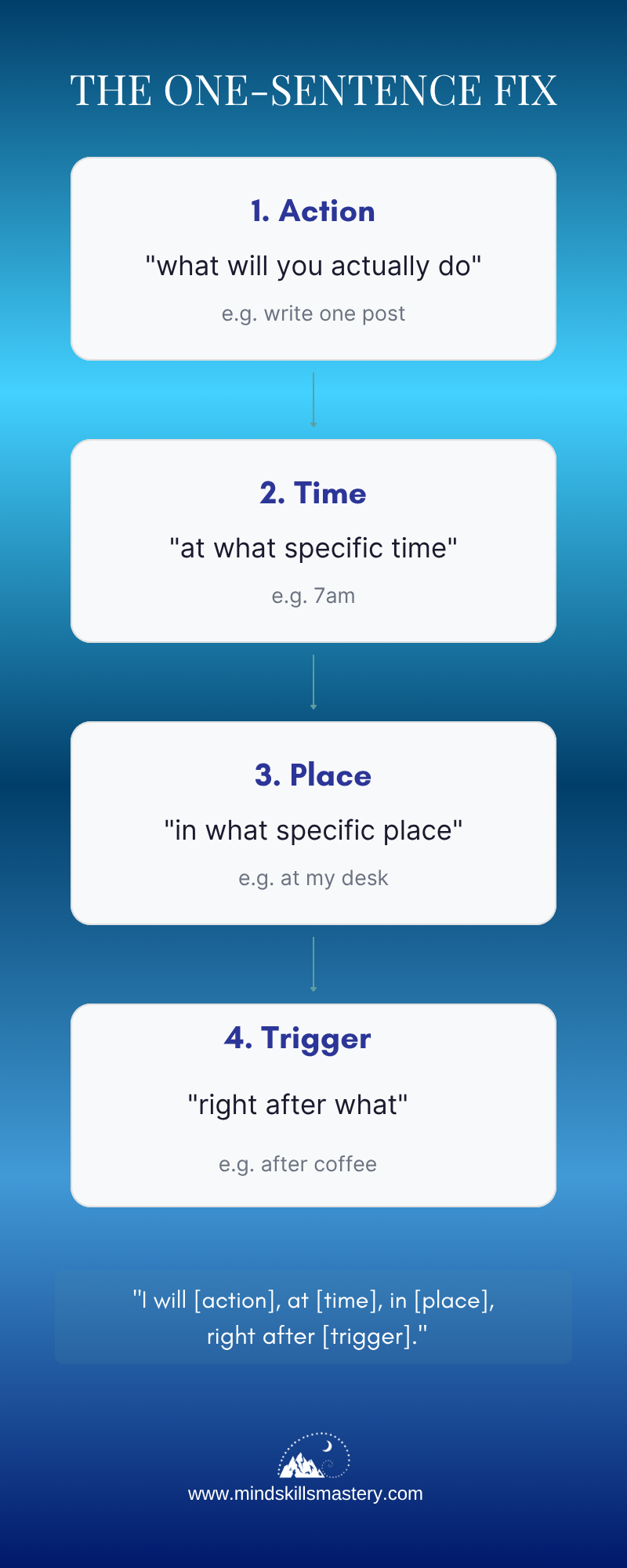
This is where it gets useful, because someone already tested the fix, and it isn't "try harder."
Psychologist Peter Gollwitzer tested this properly. He gave one group of people a goal. Nothing else. He gave a second group the exact same goal, plus one sentence in this shape: "I will do X, at this time, in this place, right after I do this." That's the whole intervention. No pep talk. No extra motivation.
The second group did the thing far more often. Not just in this one study either. When researchers later pooled everything that had been tested, 94 separate studies, more than 8,000 people, the result held up across all of it. Different goals, different people, same gap, same fix.
So what changed? Three small details got bolted onto a goal that was already there: a time, a place, and a trigger, something that happens right before it. That's the whole trick. The information or course already told you what to do. It never told your brain when, where, and what happens right before. That's the difference between "I should" and "I did."
One Sentence in Action
One of my clients runs a service-based business. He had almost finished a marketing course, and had a content plan he could recite from memory, word for word. He didn't have an information problem. He had a "post more often" intention with no day, no time, and nothing to trigger it. We changed it to "every Monday, 7am, before I open my inbox, I write one post." His output went from almost nothing across two months to four posts a week. No new course required.
Why This Is Worth Fixing
It's easy to read this and think: fine, I've wasted a bit of money on courses I never finished. Mildly annoying. Not actually a crisis.
But the gap rarely stays in the folder. It's the same gap behind the business plan you've had in your head for two years. The boundary you keep meaning to set with a client. The email you keep meaning to send. Different context, same gap.
And it doesn't stop with any one of these. Every time it repeats, in whichever folder or context it's hiding in, you're not only collecting unfinished things. You're collecting evidence that you're someone who doesn't follow through. That's the real cost. Not the course fee, or the time, or whatever else it cost you. What you started believing about yourself.
Try This Today
Pick one thing sitting in your own folder. Just one.
Don't ask yourself what to learn next. Ask: when exactly, where exactly, and what has to happen right before it that you can use as the trigger.
Write the sentence in that shape: "I will [action], at [time], in [place], right after [trigger]." That single sentence will outperform most of what's sitting unfinished on your hard drive.
One Caveat
The fix above works when the missing piece is the plan. But sometimes you build the plan, attach a time and a trigger, and still don't move. That's not an intention problem anymore. That's resistance, a part of you quietly protecting an identity, a relationship, or a sense of safety that change would threaten. Different problem, different fix, and I've written about that one separately if it sounds familiar.
What's true either way: nothing here means you're broken, or behind, or the only one with an unopened folder. It means the plan was missing one piece, or something else was going on underneath it. Different things work for different people, so if neither of these sounds quite like you, comment below and tell me what is. I'd love to know.
Want the Longer Version of This Process?
What's above is the short version of one of the oldest tools in the NLP kit, the Well-Formed Outcome process. It asks a few more questions than the one sentence above (where, when, how, with whom, and what you'll see, hear, and feel once it's done), and it's the same process underneath nearly every goal that's ever been achieved.
Get the free Well-Formed Outcome workbook here →https://www.mindskillsmastery....
FAQ
Why do I buy courses and never finish them? Buying feels like progress on its own. You made a decision, you got the confirmation email, you got a little buzz of relief. Your brain counts that as movement. It's handbrake-on movement though, revving hard, going nowhere.
Is it normal to buy something and never use it? Completely normal. Most people who fully mean to change still don't follow through, not because they don’t care, but because they don’t attach a specific time and trigger to the plan.
What is the Intention-Action gap? It's the gap between meaning to do something and doing it. Researchers have studied it for decades, and it shows up even when someone really means it.
How do I finish something I've started? Stop relying on motivation. Attach the action to a specific time, place, and trigger instead: "I will do X, at this time, in this place, right after this thing I already do." It works better than almost anything else thats been tested.
Does buying a course count as taking action? It is an action, or the decision to start. It's not the one that changes anything though. What works is something much smaller: picking one specific task from the course, and doing it at a time you've already set.
References
Gollwitzer, P. M. (1999). Implementation intentions: Strong effects of simple plans. American Psychologist, 54, 493-503.
Sheeran, P. (2002). Intention-behaviour relations: A conceptual and empirical review. European Review of Social Psychology, 12, 1-36.
Sheeran, P., & Webb, T. L. (2016). The Intention-Behavior Gap. Social and Personality Psychology Compass, 10(9), 503-518. The Intention–Behavior Gap
Categories: : Mind Skills