Why You Spend Entire Meetings Focusing on the Wrong Things
 Karren Kerrisk


Tired of wasted meetings? Learn how a simple NLP chunking technique helps you steer workplace conversations out of the weeds and get results.
You walk into the meeting wanting one thing: a simple yes or no on the project.
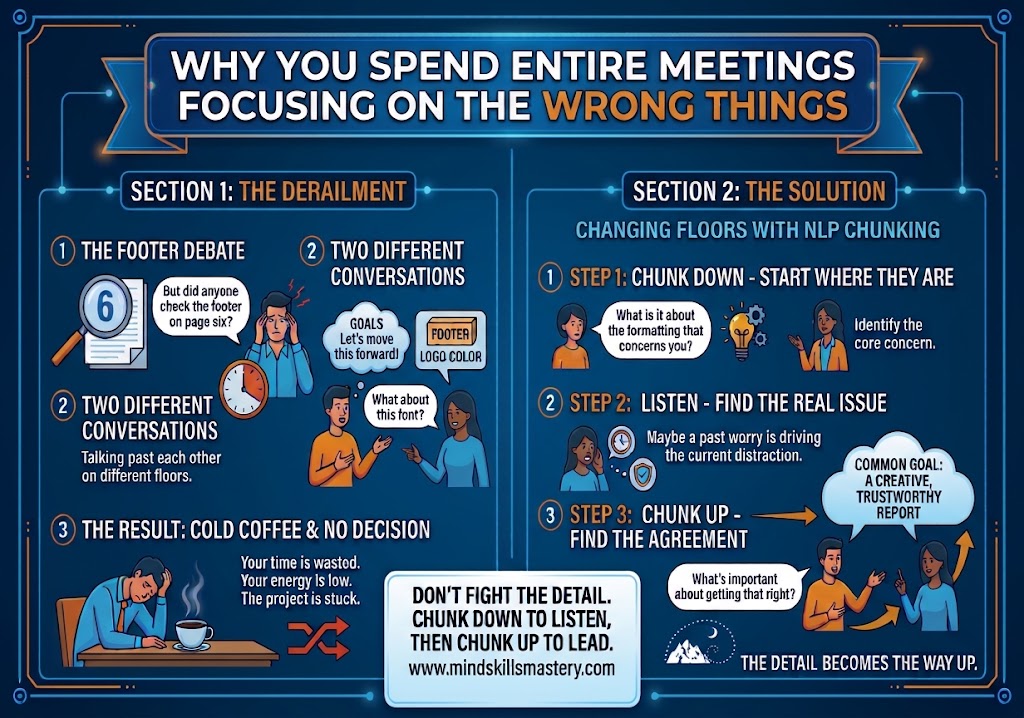
You open your mouth to say so, and the person across the table gets in first. "Before we start, did anyone check the footer on page six?"
Page six. The footer.
You smile. You nod. You answer the footer question. Then you try again, with a bit more sparkle, and somehow end up debating whether the logo is the right shade of blue. By the time you leave, your coffee is cold, your shoulders are up around your ears, another hour has dissolved into a wasted meeting, and you're no closer to a decision than when you sat down.
Afterwards, you give yourself a talking to. Be more patient. Prepare better. Try harder next time.
Except you weren't short of patience. You were having two different conversations at once.
Most of us try to solve a stuck conversation by pushing harder on our own level, repeating our point louder, sharing more data, or clinging tighter to the agenda. But when a meeting stalls, it's rarely because you lack willpower. It's because you are shouting across a vertical gap.
Think of a conversation as a multi-story building. You are standing on the top floor, looking at the panoramic view of the project's purpose and long-term direction. The person across the table is standing down in the basement, examining a single brick in the foundation - like the footer on page six. Neither of you arewrong. You're just marooned on different levels. When you try to get them up to your floor without stepping down to meet them first, you aren't communicating; you're just yelling up and down the stairwell.
The fix isn't trying harder. It's shifting levels.
A simple move from NLP
The word chunking comes from psychologist George Miller's work on memory. In NLP we use it to mean moving a conversation between specifics and intention or detail and purpose. It's a plain little tool, and the trick is to do it with a question rather than a speech.
Take that manager who keeps coming back to the formatting of a client report. Rather than launching into your overview, start where they are. Ask, "What is it about the formatting that concerns you?" That small question tells them you've heard them, and it often shows you what's really going on. Perhaps a client once complained about inconsistent tables, and now every report carries that worry. This is chunking down.
Once they feel heard, you can chunk up. Ask, "What's important about getting that right?" They might say, "I don't want the client to think we're careless." Now you're no longer talking about fonts. You're talking about trust. You can follow it with, "What would we like this report to say about us?" and you're both standing on the same floor, looking at what you actually want from the meeting.
The detail didn't get dismissed. It became the way up.
Why this matters more than it seems
Most misunderstandings aren't about what people say. They're about the level they're on when they say it.
Someone tells you, "Communication in this team is terrible." That's a big, sweeping statement. It could mean missed emails, unclear deadlines, or one awkward conversation last Tuesday. If you answer at the same sweeping level ("Yes, we really need to improve communication"), you'll both nod and nothing will change, because neither of you knows what you're agreeing to fix.
Ask them to chunk down, "What happened that made you say that?", and suddenly you have something real to work with. A date, a person, a moment.
It works the other way too. If a conversation has drifted into talk of alignment and synergy and nobody can say what happens next, ask, "What would that look like on a Monday morning?" Watch how quickly it lands.
Many of the questions we use in NLP, including the Meta Model questions, do exactly this. They move a vague statement down to something specific. Once you notice that, a lot of conversations start to make more sense.
Listen before you choose a direction
One thing worth knowing first. A person who loves detail and a person who is worried can sound exactly alike. Go down first, listen, and you'll hear which one you've got. Moving up too fast with a worried person feels like being brushed off.
What changes
You won't win every time. Some days the footer wins. But once you can hear which floor someone is on, you stop being dragged around the building. Communication isn't a knack that some people have and others don't. Conversations have their own architecture, and you can learn to move around inside the building.
The next time you feel a conversation dragging you into the weeds, don't fight it. Ask one "what specifically" question, find out what floor they're standing on, and watch how quickly the room changes.
Frequently Asked Questions
Q: Why do meetings always seem to get hijacked by minor details like formatting or wording?
A: Because you and the other person are standing on different "floors" of the conversation. While you are focused on the high-level purpose and direction, they are focused down in the operational details. Neither of you are wrong-you're simply speaking at different levels.
Q: What does "chunking" mean in this context?
A: Originating from psychologist George Miller's research on memory, "chunking" in NLP is the practice of consciously moving a conversation up (toward purpose and values) or down (toward specifics and details) using targeted questions rather than speeches.
Q: How do I stop a meeting from derailing without making the other person feel dismissed?
A: Go down first. Never brush off someone's concern. Ask a "what specifically" question to understand their worry (e.g., "What is it about the formatting that concerns you?"). Once they feel heard and understood, you can naturally chunk up to the shared goal.
Q: What is the main cause of wasted meetings?
A: Most wasted meetings happen because miscommunication isn't about what is being said, but the level at which it's being said. When two people argue across different levels (like a sweeping statement versus a microscopic detail), the conversation loops in circles and nothing gets decided.
Q: How can I apply this immediately in my next meeting?
A: Next time a conversation drags you into the weeds, resist the urge to fight it. Ask a single clarifying question to find out what floor the other person is standing on, align with them briefly, and then guide the conversation back up to what you actually need to achieve.
Further reading
- Miller, G. A. (1956). The Magical Number Seven, Plus or Minus Two: Some Limits on Our Capacity for Processing Information. Psychological Review, 63(2), 81-97.
- Chunking (psychology), Wikipedia. A free, readable overview of Miller’s idea.
- A Neuro-Linguist’s Toolbox: Language, The Hierarchy of Ideas, Kluwer Mediation Blog. A mediator’s account of chunking up, down and sideways in negotiations.
Categories: : Communication, NLP
We never share your details with anyone. Ever.