I Teach Goal Setting. So How Did I Manage to Write This?
 Karren Kerrisk
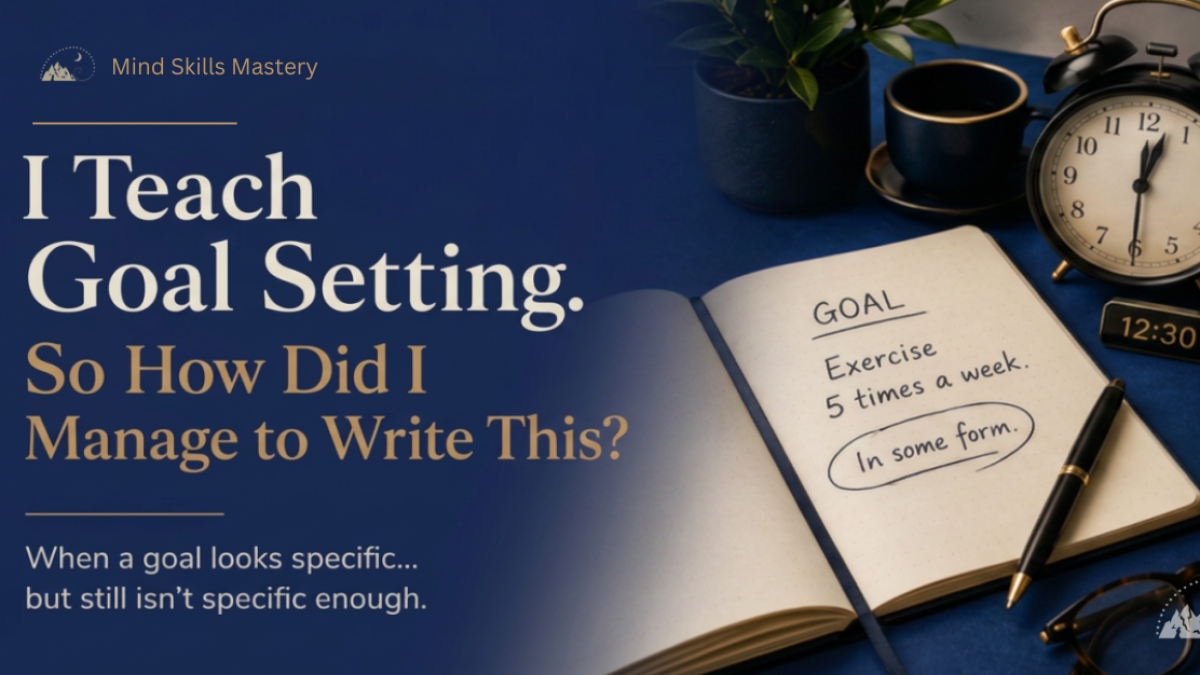
I wrote a goal down last month
"I will exercise five times a week. In some form."
At the time I was quite pleased with it. It had a number in it, and it was certainly an improvement on the vague "I really need to get back into exercise" that had been floating around my head for months without producing any actual exercise. I put it in my Notes app under a heading, which is generally where my good intentions go to be stored, and got on with my day.
A few days later I read it again. And that's when I noticed the last three words.
In some form.
Twenty one years in NLP. Sixteen of them as a trainer, teaching people how to turn what they want into something they can actually do. And there it was in my own Notes app. A goal that looked perfectly respectable at a glance and told me almost nothing about what happened next. Which was mildly embarrassing. It was also useful, because I did what I'd do with a client and pulled it apart.
What exactly was I going to do? When? Where? What would happen immediately before? And how would I know I'd actually done it?
"In some form" was apparently meant to cover all of that. It covered none of it.
Why Goal Setting Doesn't Work When the Goal Looks Fine
We've all been told a good goal should be specific and measurable. So we put a number in it, and because the number makes it look finished, we stop.
"Five times a week" sounds specific. It has a number. It's measurable. It looks like a proper goal. But it doesn't tell me what I'm doing at 12:30 on Tuesday.
Nor does "ten thousand steps", or "two litres of water", or "three posts a fortnight". They tell me how much. They don't tell me what happens when the moment arrives and I'm at my desk, looking at the clock, wondering whether I can squeeze it in later. Later is a fascinating place. A lot of good intentions live there.
Specificity really does matter. Locke and Latham spent thirty five years researching goal setting and found that specific, hard goals beat being told to do your best. Their summary is short: "when people are asked to do their best, they do not do so" (Locke & Latham, 2002, p. 706).
The number is just one part of the job. It tells me how much, and nothing about what, when, where, what happens immediately before, or what evidence I'll have afterwards.
Mine sat in my Notes app for four days looking entirely reasonable. I'd probably have defended it to a client if one had asked. Meanwhile I hadn't exercised. And when nothing happened, my first thought wasn't "ah, badly constructed goal". It was that I needed to sort myself out and be more disciplined.
Which is interesting. We've just gone from a problem with the goal to a problem with me. Those are two very different things.
Where I Actually Was
This is the part that gets skipped, because it isn't nearly as enjoyable as deciding what you want.
We jump straight to the outcome. What do I want? Five times a week. Off we go.Except, where am I starting from?
Nowhere near five times a week. I've had a back operation, and I've restarted more times than I can count. There was the personal trainer, which went well until travel and conferences got in the way. Then there was tai chi, which I love, although that particular class involved a surprising amount of gossip and chatter while waving our arms at imaginary clouds. Tai chi wasn't the problem. That class was something else.
The pattern is consistent. I get going, do well for a fortnight, something happens, and the routine disappears without me noticing when it stopped. So my honest starting point isn't a five. It's a zero. And if I write a goal for someone starting at five, I've written it for a version of me who doesn't exist.
Then the question I nearly missed.
What's already working?
I meditate every weekday morning and have done for years. Not weekends. That was never the deal. So I already know something about myself. I can hold a behaviour when it's attached to a fixed time and an existing routine. That's useful information, and I'd been designing the exercise goal as though I had none of it.
We do this constantly. We look at the thing that isn't working and start trying to fix ourselves, when something already running beautifully is sitting right there with the answer in it.
So I Rewrote It
Second attempt:
"I will exercise at lunchtime, every weekday. Options are walk, tai chi, treadmill, or resistance training. Minimum twenty minutes, more is better."
Better. A time, a frequency, real activities, and a minimum I can hit on a bad day. Still not finished though, because lunchtime isn't a time. It's a window, and a window isn't a trigger. There's also the choosing. Four options sounds flexible and sensible, until 12:30, when I'm standing there thinking, right, which one? That version of me has emails, possibly a sore back, and no appetite for decisions.
And then there's "more is better". Is it? Eventually twenty minutes will start feeling like the lazy option. I'll know I could have done forty, and twenty stops being success and starts being not enough. Once a perfectly good habit becomes another opportunity to judge yourself, we're going the wrong way.
The Third Version
"At 12:30 every weekday my alarm goes. When it goes I stop what I'm doing, change, and move for at least twenty minutes.
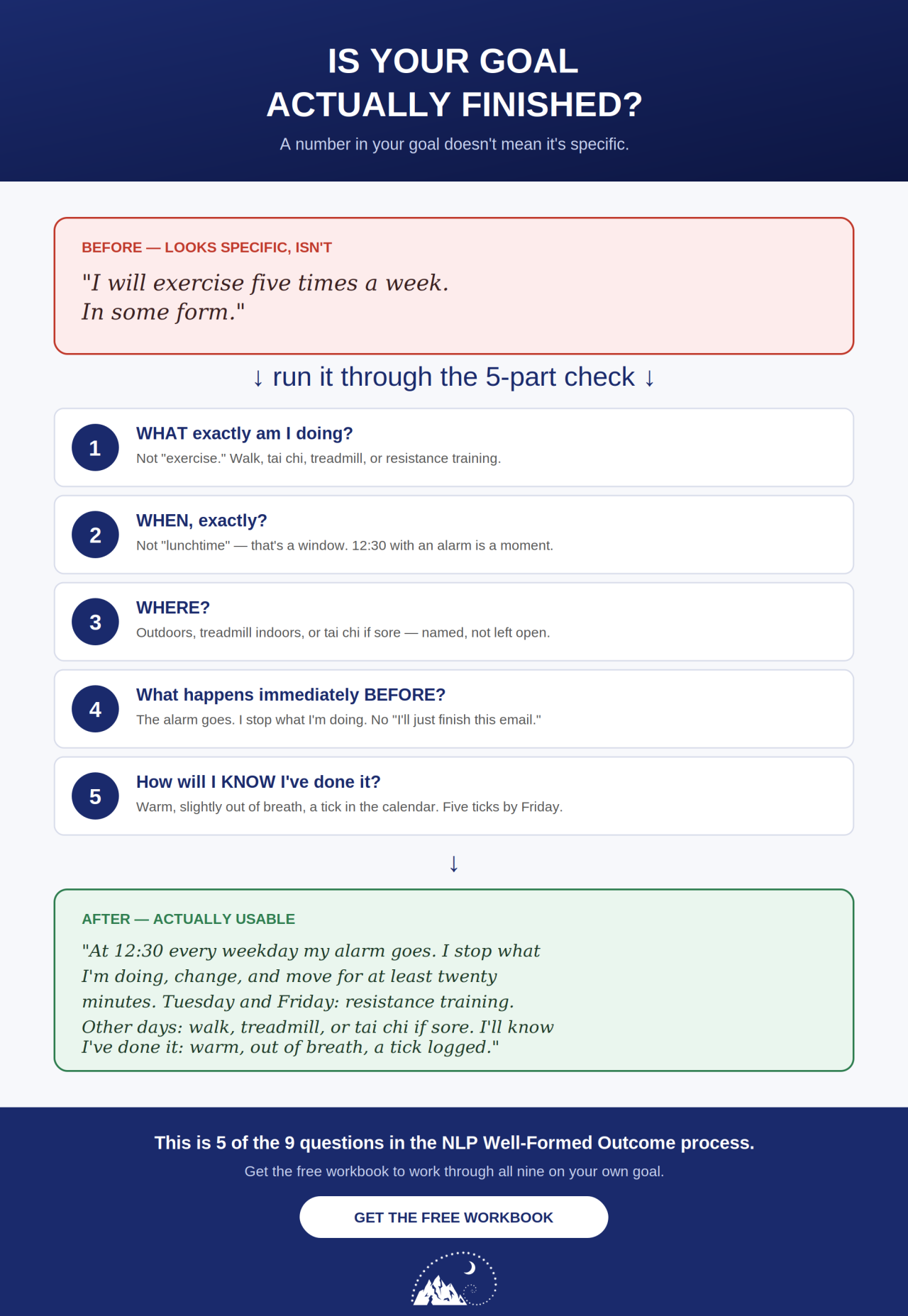
Tuesday and Friday are resistance training. The other three days I walk outdoors, or use the treadmill indoors if the weather's against me, or do tai chi if I'm sore. I'll know I've done it when I'm back at my desk, warm, slightly out of breath, with a tick in the calendar. Five ticks by Friday."
The alarm is the piece that was missing. Lunchtime is a window. 12:30 with a sound attached is a moment.
"I stop what I'm doing" matters too, because otherwise I know exactly what happens. The alarm goes, I think I'll just finish this email, another one appears, and half an hour has gone on something that could easily have waited. My inbox has a very strong sense of timing.
Tuesday and Friday are decided. The other three days have a default and two substitutions. The weather doesn't get to cancel it and neither do my legs.
"More is better" has gone. Twenty minutes is the minimum and the minimum is enough. I'm not trying to prove how motivated I am. I'm trying to build something that happens.
And then the bit almost everyone leaves out. How will I know? Not a vague sense of having been good this week. Not standing there on Friday trying to remember whether Tuesday counted. Warm, slightly out of breath, a tick in the calendar, five ticks by Friday.
The whole rewrite took about four minutes. Four minutes on a goal statement I'd already written once and thought was fine.
Which makes me wonder how many goals get abandoned for a discipline problem that was actually a design problem.
It Isn't Just Me
A client came to me wanting to join the 5am club. She'd researched it properly and knew what she wanted from the hour. Exercise, an hour on her business, reading, and some quiet before the day started.
Four things. One hour. No decision about which happened when.
So I asked her something that seems obvious once it's said. Are you waking at 5, or waking at 4.45 so you're up and functioning by 5?
She didn't know. Then I asked what happened at 5. She didn't know that either.
Meanwhile she had a dinner routine that ran like clockwork. Every night, same sequence, no negotiation, no standing in the kitchen wondering what her evening should look like. It just happened. So we started there. What does the dinner routine have that the 6am routine doesn't? A fixed time, a fixed sequence, and nothing to decide once it starts.
She rewrote it: "I'll wake at 4.45 and be ready for 5. Every morning at 5 I'll stretch and step outside for five minutes. Mondays, Tuesdays and Fridays I'll work on my business for an hour with my laptop and my coffee. Wednesdays and Thursdays I'll read with my coffee."
The 5am question is answered. The four competing options are now five named days, so there's nothing to decide at five in the morning, which is not the hour for a committee meeting with yourself. And five minutes outside is small enough that a bad night's sleep won't cancel it.
Same fix, different life. She didn't need more discipline. She needed the sentence to say what actually happens.
So What About Yours?
You've probably got one. The goal with a number in it that looks sensible and hasn't moved. Read it out loud. Not in your head. A sentence that looks respectable on a screen often gives itself away when you hear it.
Then ask what exactly you're doing, when, where, what happens immediately before, and how you'll know you've done it. Most goals answer one of those. And before you rewrite anything, two questions. Where am I now, not where I wish I was. And what's already working? Not for a gold star. Whatever's already running well in your life probably contains the blueprint for the thing that isn't.
If the goal itself is vague, there's no sense beating yourself up about follow through when you were never given anything to follow. That's what I'd done. I hadn't failed to stick to my goal. I'd written one that wasn't well formed.
You may not need more motivation. You may just need a better goal statement.
Where This Comes From
The Well Formed Outcome is one of the oldest tools in the NLP kit, and it exists for exactly this reason. It isn't about writing a goal that sounds impressive. It's about working out what has to be true before the outcome becomes something you can do.
It asks nine questions. My original goal statement answered two of them. I teach this. Which is a reasonable demonstration that knowing something and applying it are two different things.
Want to Try This With One of Yours?
The free Well Formed Outcome workbook takes you through all nine questions and gives you somewhere to actually answer them. Knowing the questions is one thing. Sitting down and working through them is another.
Get the free Well Formed Outcome workbook here
FAQ
Why do I keep failing my goals? Usually because the goal only looked specific. A number tells you how much, not what, when, where, or what happens immediately before. Without those four, there's nothing to actually do on a Tuesday.
Why doesn't goal setting work even when I make my goal specific? Specific often gets read as measurable, and a number is only the measurable part. It still needs a time, a place, a trigger, and a way to know it's done.
Why do I stop new habits after a couple of weeks? Week one runs on novelty. Week two needs structure. If the goal never had a time and a trigger attached, week two has nothing to hold onto, and the drop-off gets read as a personal failing rather than a design fault.
Should I set an easier goal instead of a hard one? Set an honest minimum rather than an easier one. A minimum you'd hit on a bad day beats an ambitious number you'll miss and abandon, because you're building the habit first, not the performance.
What is the Well-Formed Outcome in NLP? It's a nine-question framework from NLP for building a goal that's actually usable, covering the outcome itself, your present state, the evidence you'd see and hear and feel, the context, your existing resources, achievability, ecology, why it matters, and the first action.
References
Locke, E. A., & Latham, G. P. (2002). Building a practically useful theory of goal setting and task motivation: A 35-year odyssey. American Psychologist, 57(9), 705 to 717.
Categories: : Goals