How to Change Your Inner Voice with NLP in Minutes
 Karren Kerrisk
You're about to walk into a room. A meeting, a difficult conversation, a moment that actually matters. And right on cue there it is. That voice. Not the words. The tone. The one that sounds like it has already decided how this is going to go, and it isn't good.
You know the one.
It's not what it's saying that's the problem. It's the way it says it. The harshness of it. The speed. The way it sits right behind your eyes like it's got a front row seat to your life and a running commentator contract you never signed.
That tone is costing you - in the seconds before the conversation starts, in the moment you're about to try something, in the way you carry yourself when nobody's watching. Confidence doesn't get shredded by ideas. It gets shredded by delivery. The voice's delivery.
Here's the thing that changes everything: most advice focuses on what your inner voice is saying. NLP focuses on how it's saying it. And that one shift - from content to structure - is what makes the difference between another exhausting round of "think positive" and an actual change you can feel in minutes.
The Difference Between Content and Structure
Most approaches to negative self-talk focus on the words. Identify the thought. Challenge it. Replace it with something better. Write it down. Argue back.
And there's a reason that approach feels like hard work: you're essentially trying to win an argument with yourself. One you've been having for years. Using logic on something that was never interested in logic to begin with.
NLP looks at it differently. It's not just what the inner voice says that gives it power. It's the structure of how it sounds - what NLP calls auditory submodalities. The volume. The speed. The tone. The location it seems to come from. The quality of it.
The concept of submodalities - the structural qualities of our internal representations - was developed by Richard Bandler as part of the NLP model. These qualities are not fixed.
Think about the difference between a sharp, fast, close voice telling you that you're going to mess this up, and that same sentence delivered slowly, quietly, from somewhere across the room, in a tone that sounds like a very bored stranger reading from a bus timetable.
Same words. Completely different experience.
The charge isn't in the content. It's in the delivery. Change the delivery, and the content loses its grip.
Why Affirmations Don't Actually Work
This one's worth saying clearly, because a lot of people have wasted a lot of time on Post-it notes.
When the inner voice is running at full volume - loud, fast, strong - and you paste a cheerful affirmation on top of it, what you've done is add a second voice. Now you've got the original critic and the affirmation having a standoff. The critic, for the record, is very well practiced. The affirmation is brand new. This is not a fair fight.
The problem isn't positive thinking as a concept. The problem is operating at the wrong level. You're trying to change the soundtrack by changing the lyrics while the music is still playing.
What actually works is changing the music.
What NLP Actually Changes and Why It's Fast
In NLP, internal dialogue is treated as an auditory internal representation - a sound your brain is generating. Like any sound, it has qualities: volume, speed, pitch, tone, and location (where it seems to come from in or around your body).
These qualities aren't fixed. They feel fixed, because you've been running the same configuration for years and it's become automatic. But they're fully adjustable - and your nervous system responds to the adjustment immediately, not eventually.
Here's the part that neuroscience backs up: when you shift the structure of an internal experience - the way it feels and sounds - the emotional response to it changes at the same time. Psychologist Ethan Kross, whose research at the University of Michigan examined how people relate to their inner voice, found that creating distance from internal chatter - changing how you engage with it rather than fighting the content - reduced emotional reactivity and improved performance under pressure. His book Chatter is well worth a read.
The NLP submodalities approach does exactly this, but by working on the sound qualities themselves rather than just your relationship to the words.
Before You Change It, Find It
Most people have never actually stopped to notice the qualities of their inner voice. They know it's there. They know it's often unhelpful. But they've been so focused on what it says that they've never looked at or listened to how it says it.
So start here.
Think of something the inner voice says often. A familiar, recurring statement. Not the most loaded one - just a recognisable one. Let it play. Then notice:
- Where does it seem to come from? Right inside your head? A specific spot - behind the eyes, at the back of the skull, over one shoulder?
- How loud is it? Does it feel close or distant?
- What's the speed? Fast and relentless, or slower and heavy?
- What's the tone? Critical? Flat? Impatient? Does it sound like anyone you recognise?
You're not analysing the statement. You're noticing the delivery. That's the thing you're going to change.
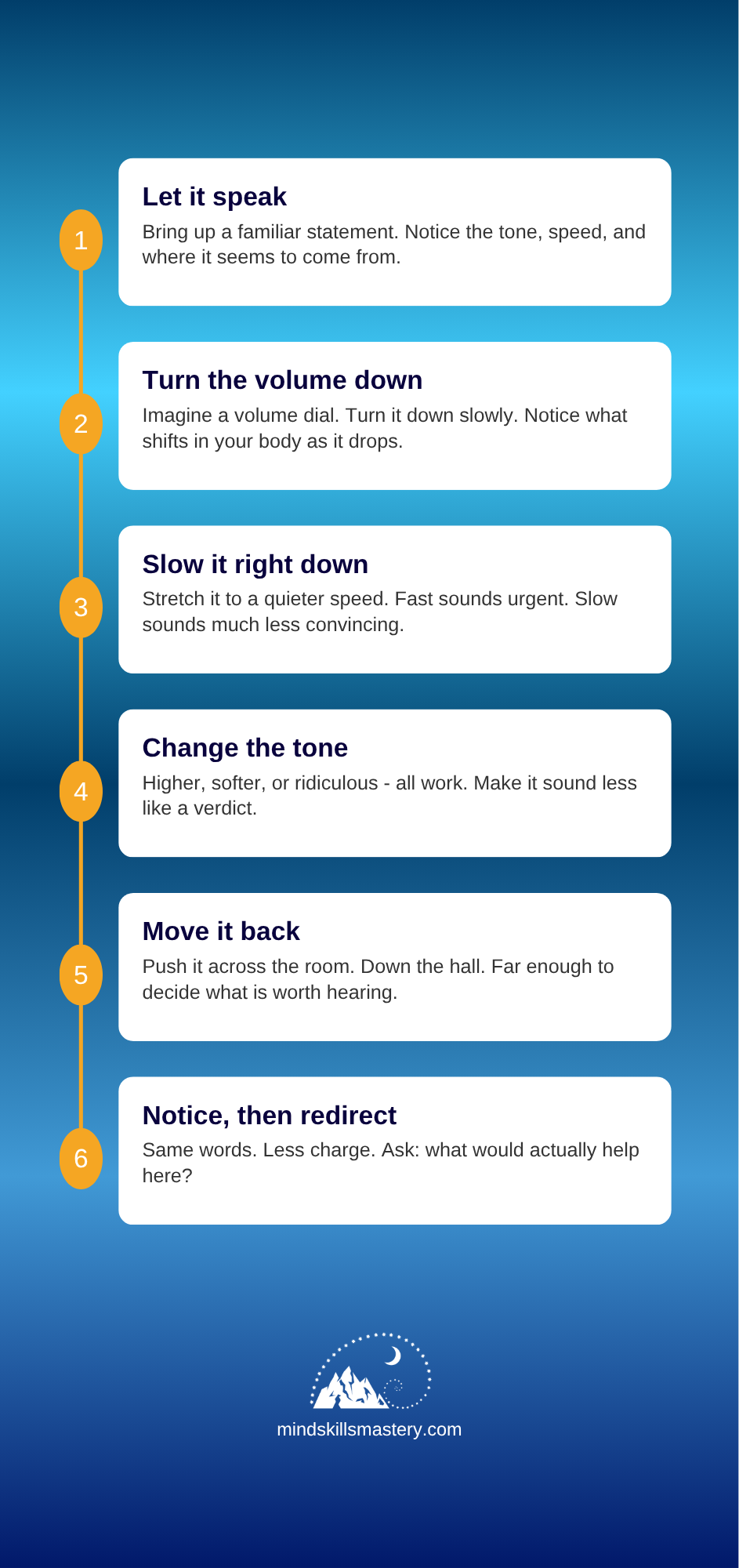
The Six-Step Technique - Change the Voice Itself
Work through this once slowly the first time. After that it takes about thirty seconds.
Step 1: Let the voice speak
Bring the familiar statement forward. Let it say what it says in the way it normally says it. Notice the full delivery, all those qualities above.
Step 2: Turn the volume down
Imagine a dial. Not a metaphor - actually picture one, right in front of you. Reach out and turn it down. Watch the number drop. The words are still there, but they're getting quieter. Keep going until it's barely a murmur. Notice what happens in your body as the volume drops.
Step 3: Slow it right down
Take that voice and stretch it. All the way out. A sharp, fast critic at half speed sounds less convincing. At quarter speed it sounds faintly absurd. Let it get absurd. That's the point.
Step 4: Change the tone
This is the step people find either strange or very funny. Both are fine, and funny is actually more effective. Give the voice a different quality. Higher pitch. A different accent. A cartoon character. I'm partial to the chipmunks, but the Smurfs are fun too, but honestly whatever strips the authority from it works for you. The goal isn't to mock yourself. The goal is to break the spell of a voice that's been passing itself off as TRUTH, and nothing breaks a spell faster than making it sound ridiculous.
I've done this standing in a supermarket car park. Worked perfectly. Strange looks fully worth it.
Step 5: Move it back
If the voice feels close - right behind your eyes, sitting on your chest - push it back. Imagine it stepping away. Across the room. Down the hall. Outside the building. Still there if you want to check what it's saying, but no longer operating at point-blank range.
Step 6: Notice the result, then redirect
Take a breath. How does that statement feel now? In almost every case the emotional charge has dropped significantly, sometimes completely. The words haven't changed. The delivery has. And it turns out that's where the power was.
From here, you could replace the statement with something more accurate and useful: not a chirpy affirmation, but an honest question. "What do I actually need right now?" or "What would help here?" Your brain goes where you point it. Point it somewhere worth going.
When It Starts Again
The voice will come back. Not because the technique didn't work, because the pattern has been running for a long time and patterns don't dissolve in one session. Expect that. Plan for it.
When it restarts, don't argue with it. Don't try to suppress it. Just go straight back to Step 2. Volume down, speed down, location back. You're not trying to destroy the voice. You're just done letting it set its own tone and volume.
Two weeks of using this consistently is usually enough to notice the voice losing its automatic authority. The statements are still there. The grip is different. And once the grip is different, you can actually evaluate what the voice is saying from a useful distance, rather than just absorbing it as fact.
What the Research Shows
The science here sits in two places. The first is in the neuroscience of neuroplasticity - the well-established finding that neural patterns, however ingrained, are not permanent. Michael Merzenich's research on brain plasticity consistently showed that the brain can build new patterns and weaken old ones through deliberate, repeated practice. The inner voice pattern you have now was learned. It can be retaught.
The second is in what Ethan Kross's research demonstrates about psychological distance. When people shift how they relate to their internal chatter - rather than being absorbed in it - their emotional reactivity drops and their capacity to perform under pressure improves. The submodalities approach creates this distance structurally, at the level of how the voice sounds, which tends to be faster and more durable than cognitive strategies alone.
Remember not everything works for everyone. If you're dealing with significant mental health challenges, a qualified professional is the right support. This technique is a practical self-management skill, not therapy.
When it works
"It's like having a very confident colleague," she said, "who has never once been right, but has never once doubted themselves either."
We found the voice quickly - fast, close, running its verdict on everything she did before she'd finished doing it. We changed the delivery: slowed it right down, moved it to the back of the room, shifted the tone from authoritative to something considerably less impressive (Smurfette came to play) She got very excited. Now she had something that actually worked.
She said "Some of what it says is actually useful. I just couldn't hear it when it was being so mean."
Not silence. Distance. Tone. That's the difference.
Want to Go Deeper?
"I've done therapy, read all the books, tried meditation. This is the first thing that's actually stuck." - Melissa, HR Manager
There are five practical NLP tools inside the free Mind Reset ebook - written in plain english you can use today, easy to apply.
Download The Free Mind Reset E-book here
References
Bandler, R. (1985). Using Your Brain — For a Change. Real People Press.
Kross, E. (2021). Chatter: The Voice in Our Head and How to Harness It. Crown.
Merzenich, M. M. (2013). Soft-Wired: How the New Science of Brain Plasticity Can Change Your Life. Parnassus Publishing.
Frequently Asked Questions
Why does changing the sound of the voice work when changing the words doesn't? The emotional impact of your inner voice doesn't come only from what it says - it comes from how it says it. Volume, speed, tone, and location all contribute to whether a statement feels like truth or just noise. NLP works on those structural qualities directly, which is why shifts tend to happen faster than with content-focused approaches alone.
I've tried things like this before and they haven't stuck. Why would this be different? Most approaches work on what the voice says. This one works on how the voice sounds - the submodalities. That's a different level of the pattern, and in most cases a more direct route to change. It also doesn't require belief or weeks of practice before you notice anything. The first time tends to produce a noticeable result, which makes it easier to keep using.
Can I use this for a really harsh inner critic, not just mild self-doubt? Yes - and it's often most effective with the harshest statements, because those are the ones where the delivery carries the most weight. Start with a medium-intensity example first to get the feel of the technique, then work up.
Is this something I need a coach or therapist for? This technique is a practical self-management skill you can use on your own, today. It's not therapy. If you're dealing with significant mental health challenges, a qualified professional is the right support. This is a complementary tool for everyday patterns and performance.
How often do I need to use this before I notice a lasting shift? Most people notice an immediate shift in the first use. For the pattern to change durably - for the voice to lose its automatic authority over time - consistent use over two to three weeks tends to be enough for most everyday thought patterns.
Written by Karren Kerrisk,Trainer in Classic and New Code NLP and Founder of Mind Skills Mastery.
Categories: : NLP