5 Evidence-Supported Mental Skills for a Happy, Healthy Life
 Karren Kerrisk
Here's something the personal development industry doesn't love to admit.
Most of it isn't actually backed by research.
Not all of it. Some of it is very useful. But a lot of what gets sold as life-changing is really just someone's good idea, a decent framework, a good marketing budget and a lot of enthusiasm. Which would be fine except that when it doesn't work for you, the industry has a very tidy explanation ready: you didn't want it badly enough. You didn't commit. You gave up too soon.
So the problem was you. Obviously.
Except it probably wasn't. There's a good chance the problem was simply that nobody told you which things actually have solid science behind them and which ones are mostly just vibes with good marketing.
So that's what this post does. Five skills keep showing up in the research on mental health and happiness - not in one study, not from one person's opinion, but across decades of science from completely different fields all pointing at the same things. I'm also going to be straight with you about where NLP fits in, because it's not a simple yes or no, and you deserve the honest version.
Why These Five?
Because researchers who don't agree on much else keep landing on the same five things. Scientists studying stress, scientists studying happiness, scientists studying why some people bounce back from hard things and others don't. Different questions, different countries, different decades, same five skills coming up over and over.
They also happen to be the five tools in The Mind Reset, the free guide at the end of this post. Not a coincidence - the guide was built from the same research.
1. Emotional Regulation - Learning to Drive Your Own State
Picture this. It's 7am. Something small goes sideways before you've even had coffee; a message you weren't expecting, a minor thing that just lands wrong, and suddenly the whole day feels like it's running uphill. You're more short-tempered than you want to be. Nothing flows. You end up doing the thing you always do when you're in that state, which isn't the thing you wanted to do.
That's your emotional state quietly running the show. Not influencing your day. Running it.
Decades of research say the same thing: being able to notice what state you're in and shift it deliberately - rather than just being dragged along by it - is one of the most important skills for your mental health and how well you function. Scientists call it emotional regulation or psychological flexibility. I call it knowing how to change your own channel.
And here's what it isn't: it's not "calm down." It's not pretending everything's fine. It's not toxic positivity in a lab coat. It's the real ability to feel what's happening and then consciously move yourself somewhere more useful.
In NLP, this is called State Mastery. The fastest way in is almost always through the body, not the mind - because your emotional state isn't just in your head, it lives in your whole body. Change something physical and your state shifts. The Mind Reset starts here because it's usually the quickest win - and quick wins matter when you're just getting started.
2. Pattern Interruption - Hitting Pause on the Loop
You know the pattern. Something happens - a specific kind of comment, a particular kind of stress, sometimes literally just a time of day - and before you've consciously decided anything, you're already three steps into a spiral that feels familiar.
It's not a character flaw. Your brain is being remarkably efficient. It builds shortcuts for things that happen often so it doesn't have to think too hard every time. The problem is when those shortcuts are running reactions that aren't helping you. And they run so fast you don't even notice until you're already in the middle of them.
Research consistently shows that learning to catch yourself in that split second to create a decent pause between the trigger and the reaction, significantly reduces stress, anxiety, and that unsettling feeling of being out of control of your own responses. Not theoretically. In practice. And the more you practice it, the bigger that pause gets.
In NLP, pattern interruption is about introducing something unexpected right at the moment the pattern starts firing. Something that short-circuits the sequence before it gets going. Not fighting it. Not suppressing it. Just breaking the chain early, before it has momentum. Once you know how to do this, you start to feel like you have options again.
And in that pause? That's where choice lives.
3. Internal Dialogue - The Voice in Your Head Is Not Always Right
Quick thought experiment. Imagine the voice in your head - the one that narrates your day, commentates on your performance, and delivers verdicts on your life choices - was a person who followed you around saying those things out loud.
Would you keep them around?
Most people, when they start paying attention to what that voice says and how it says it, are quite surprised. Not because they're broken, but because they've never really listened. They've just been absorbing it, treating it like a reliable newsreader rather than, say, a slightly stressed-out flatmate with strong opinions and patchy accuracy.
Research on how we talk to ourselves shows it has a significant effect on our mood, our ability to handle difficult things, and how we see ourselves. Two things consistently come up. First: being consistently harsh with yourself makes things worse, not better, across multiple studies. Second: it's not just what the voice says that matters, it's whether you're completely sucked into what it's saying, or whether you have a little bit of distance from it.
The good news is that the voice can be updated. NLP has a number of ways to do this. The one in The Mind Reset is called an internal dialogue audit - two days of writing down what the voice says, then asking three questions about each statement: Is it accurate? Is it fair? Is it useful? Most of the time it fails at least two. Which is quite eye-opening when you first try it.
4. Self-Compassion - Before You Roll Your Eyes, Hear Me Out
I know. Self-compassion sounds soft. It sounds like the kind of thing that involves scented candles, a journal with an inspirational quote on the cover, and essentially giving yourself a free pass on anything difficult.
I used to think it lived exclusively in the scented candle aisle and had nothing useful to say to anyone with a deadline.
Here's what twenty years of research actually says: I was completely wrong.
Researchers define self-compassion simply as treating yourself with the same basic decency you'd offer a friend who was struggling. That's it. And the science on it is some of the strongest on this whole list. Study after study shows that people who practice self-compassion have lower anxiety, less stress, better life satisfaction, and more resilience when difficult things happen. If you want to go down the rabbit hole, this review in the research literature lays it all out. It's pretty compelling reading.
But here's the bit that surprises almost everyone: self-compassionate people don't let themselves off the hook more. The research shows they own their mistakes faster and learn from them better because they're not spending all their energy defending themselves from their own attacks. When you're not in constant fight mode with yourself, you can look clearly at what went wrong and do something useful about it.
Think about that for a second.
Being relentlessly hard on yourself isn't the engine of high performance. It's the handbrake. When your brain is running in constant threat mode - which is exactly what harsh self-criticism does - you can't think clearly, you can't take risks, you can't grow. You just defend.
The other thing research is clear on: this isn't a personality trait you either have or you don't. It's a skill. You can practise it. Which means if your inner voice currently sounds like a fairly hostile manager who's never once said well done, that's not just who you are - it's a pattern.
Patterns change.
I saw this with a client - I'll call her Sarah - who had just stepped into her first senior leadership role. She was bright, capable, and absolutely convinced that the way to become better was to critique herself harder. Pick apart every decision. Question every instinct. Question constantly whether she really belonged in the room.
She thought the self-scrutiny was making her sharper.
What it was doing instead was keeping her nervous system in constant threat mode - which is exactly the worst state for the kind of strategic thinking her role required. She couldn't see it because it had always felt like diligence. Like being responsible. Like taking her job seriously.
In our session we worked on something she hadn't considered: giving herself the same honest, proportionate, kind review she'd offer a talented colleague who was still learning. Not letting herself off the hook. Not ignoring the mistakes. Just dropping the hostility from the process.
Within a few weeks she reported back. She had a quieter head, clearer thinking, and for the first time, she felt like she belonged at the table. The strategic thinking she'd been so desperate to access had been there all along. It just couldn't get through the noise.
In NLP, working on your internal dialogue and reframing how you talk to yourself directly builds self-compassion. Which is one of the reasons all five of these skills keep overlapping with each other.
5. Outcome Thinking - Giving Your Brain an Actual Direction
Ask most people who are stuck what they want, and they'll give you a detailed, passionate answer about what they don't want.
They don't want to feel this anxious anymore. They don't want to keep having the same fight. They don't want another year to go by feeling like they're not where they want to be in their own life.
All completely understandable. As instructions to your own brain? Almost completely useless.
Here's why. Your brain goes where you point it. Tell it what you don't want and it helpfully keeps that thing in view because that's what you've asked it to focus on. You're essentially handing it a map with a big red X on the thing to avoid and no actual destination marked anywhere.
Research on happiness and goal-setting is consistent on this: people who are moving toward something specific feel more motivated, more resilient, and measurably happier than people who are just trying to move away from something uncomfortable. It sounds obvious when you say it out loud. It's remarkable how rarely we do it.
In NLP, this is worked on through something called Well-Formed Outcomes, a simple process for getting clear on what you want, how you'll know when you've got it, and what the first real step is. That last bit is crucial. Without a first step, even the clearest outcome just sits there looking nice and doing nothing.
Your brain is remarkably good at finding routes to things. It just needs an actual address to aim for.
Questions People Usually Ask
Is NLP evidence-based?
Honestly? Partly. The skills NLP works with - managing your emotional state, changing how you talk to yourself, interrupting patterns, getting clear on what you want - all have solid science behind them. The specific NLP techniques are practical tools developed by NLP Professionals, not clinical treatments tested in trials. So they're different things. NLP isn't a replacement for therapy or medical support if you need that. It's a practical toolkit for the everyday stuff. And a useful one.In my experience, it gets great results
Which of these five has the most research behind it?
Self-compassion, way above the rest. There are more studies, more large-scale reviews, and more consistent results on self-compassion than almost anything else in this space. The finding that kind people are higher performers, not lower ones, is one of the most reliably replicated results in the whole field.
How is this different from therapy or CBT?
Therapy and CBT are clinical tools delivered by qualified professionals for specific mental health conditions. What's here is practical self-development - skills for everyday life, performance, and feeling better. They can sit alongside professional support well. They're not a replacement for it. If you're dealing with something significant, please start with a qualified professional.
How quickly will I notice something changing?
Most people notice something on their first real attempt at any of these. Building a lasting shift in automatic patterns tends to take a couple of weeks of consistent practice - not months, not years. These aren't overnight miracles and they're not five-year projects either. Somewhere useful in between.
Get the Tool for Each Skill - Free
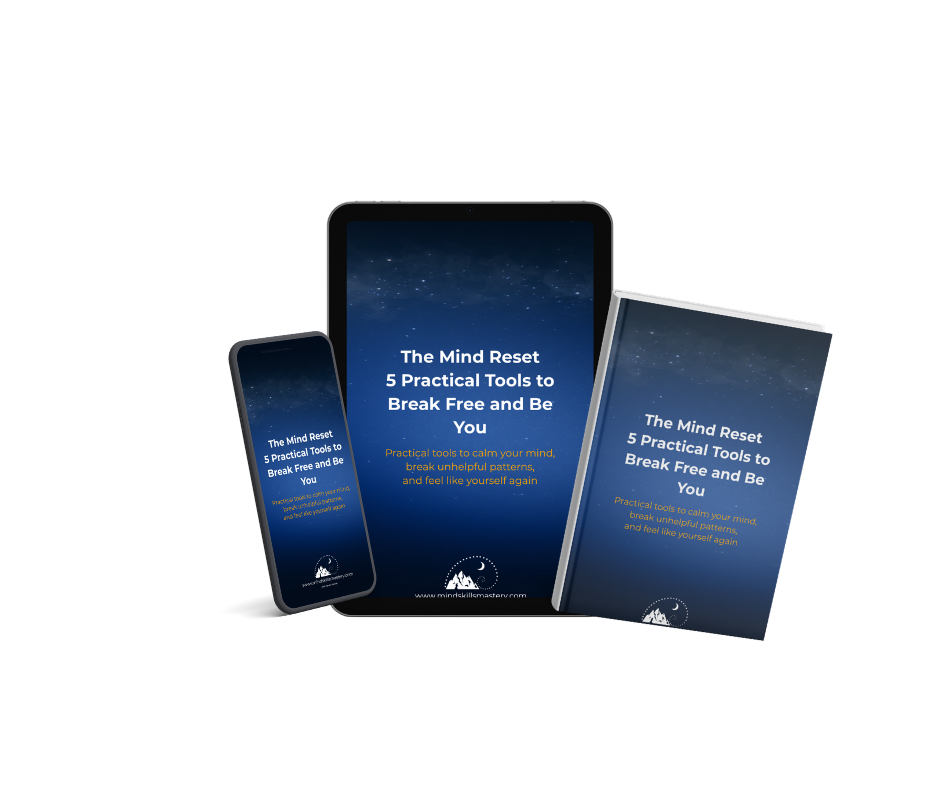
The Mind Reset covers all five of these skills with one practical tool each - something you can try today, not "when I have more time." One skill per page. Plain language. Honest about what's research and what's practitioner experience. No fluff.
It's free. It's good. And easy to do.
Download The Mind Reset - free
Written by Karren Kerrisk, NLP Trainer in Classic and New Code NLP and Founder of Mind Skills Mastery
References
Gross, J. J. (2015). Emotion regulation: Current status and future prospects. Psychological Inquiry, 26(1), 1-26.
MacBeth, A., & Gumley, A. (2012). Exploring compassion: A meta-analysis of the association between self-compassion and psychopathology. Clinical Psychology Review, 32(6), 545-552.
Neff, K. D. (2003). Self-compassion: An alternative conceptualization of a healthy attitude toward oneself. Self and Identity, 2(2), 85-101.
Passmore, J. & Rowson, T. (2019). Neuro-linguistic programming: A critical review of NLP research and the application of NLP in coaching. International Coaching Psychology Review, 14(1), 57-69.
Zessin, U., Dickhaeuser, O., & Garbade, S. (2015). The relationship between self-compassion and well-being: A meta-analysis. Applied Psychology: Health and Well-Being, 7(3), 340-364.
Categories: : Neuroscience